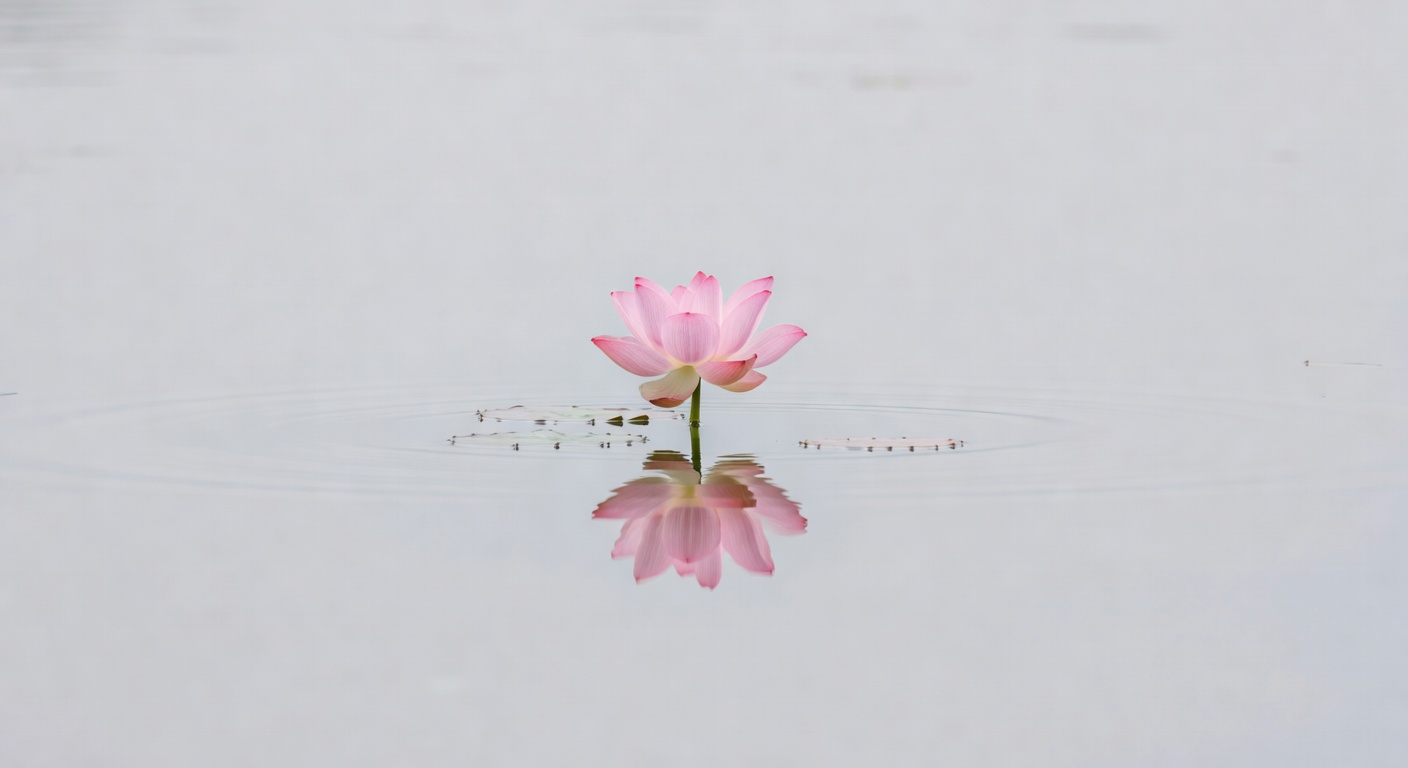
On a July morning in Kyoto, before the tourist coaches have arrived and the air still holds the coolness of the night, the lotus pond at Byodoin Temple presents a spectacle of quiet magnificence. The blossoms — white and deep rose, each as large as a cupped hand — open in the early light and close again by noon, as if the day itself were a single breath. The water beneath is still, mirror-like. The roots lie buried in the mud below, unseen.
It is this last detail — the lotus rising from murky water to bloom in pristine beauty — that has made it one of the most potent symbols in Japanese religious and artistic tradition. The flower does not merely represent purity; it enacts it, drawing sustenance from the impure and producing something luminous.
Buddhist Significance
The lotus entered Japanese symbolic life primarily through Buddhism, which arrived in Japan in the sixth century and rapidly became a dominant force in art, architecture, and thought. In Buddhist iconography, the lotus is inseparable from the image of the enlightened mind: the Amida Buddha is typically depicted seated upon a lotus throne, and the bodhisattva Kannon — the embodiment of compassion — is often shown holding a lotus blossom.
The symbolism is multilayered. The lotus grows in muddy water, suggesting that suffering and affliction are the necessary conditions from which spiritual awakening arises. The blossom itself remains untouched by the water that surrounds it, representing the quality of non-attachment — the ability to be fully present in the world without being defined by it. And the daily opening and closing of the petals connects the lotus to cycles of rebirth, renewal, and the passage of time.
"The lotus is an image of the mind itself: it arises from conditions, but it is not limited by them."
— Traditional Buddhist teaching
The Lotus in Japanese Visual Culture
Beyond its religious significance, the lotus has been a subject of artistic fascination across virtually every medium in Japanese visual culture. It appears in the decorative programmes of temples and shrines, carved in stone and painted on sliding screens; in the textile arts, as a repeated motif on formal garments; in ceramics, pressed into the clay of incense burners and sake vessels; and in the woodblock prints of the Edo period, where it provided artists with a vehicle for exploring the interplay of line, colour, and atmospheric suggestion.

Family crests — kamon — offer another dimension. Several hundred of Japan's thousands of documented family crests incorporate the lotus in stylised form. These designs reduce the flower to its essential geometric structure — concentric petals arranged with mathematical regularity — and in doing so reveal an aesthetic principle that recurs throughout Japanese decorative art: the idea that natural forms can be distilled into pure pattern without losing their identity or their meaning.
The Lotus Today
In contemporary Japan, the lotus retains its symbolic charge even as its religious contexts become more distant for many people. Temple ponds draw visitors in summer not only for devotional reasons but for the simple pleasure of the spectacle — the blossoms in the early morning light, the silence, the particular quality of a summer dawn before the city wakes.
In home gardens and public parks, water features incorporating lotus plants have become increasingly popular. Gardeners and designers speak of the plant's ability to establish a sense of contemplative calm: its unhurried growth, its regular rhythm of opening and closing, its resistance to the restless visual noise that characterises so much of the modern urban environment.
There is perhaps a continuity here with the original symbolism: the lotus as a model of something that holds its form and its integrity amid conditions that might seem to militate against them. In a city as intense and demanding as Tokyo, the sight of a lotus blossom opening in still water remains, for many, a small and reliable occasion for something that might tentatively be called peace.